Heppi
This project was an opportunity to help a company to build its services from the ground up. We went from the Business Model Canvas up until the late prototype. In this project, I participate with the company team from the first ideation meetings until the validation of the service with users. I did user research to help with the business decisions, created user-centered solutions, and tested prototypes in different stages of fidelity.
OVERVIEW
Graduation parties are a big thing in Brazil. The achievement of a college degree is something celebrated along with friends and family at a big party. A lot of student’s cohort start saving money and planning the party since the first year of their course.
Heppi is a fintech startup specialized in financial organization for these graduating events. It helps the students to plan the party and collect money safely and transparently with a simple and easy-to-use app and web-based system.
In this project, I was involved from the first ideation meetings until the last validation with users. I did user research to help with the business design, creating user-centered solutions, and testing prototypes in different stages of fidelity.
USERS
1 - Undergraduate Student Cohorts
2 - Professional Party Planners
DESIGN PROCESS
The company team presented me with a brief benchmark and some ideas in our first meeting. We began the process of filling a Business Model Canvas to start aligning our understanding of the company's overall service and functioning. After finishing the first canvas draft we started an in-depth benchmark to help us in future ideation sessions and run a survey to gather quantitative data on users.
The data we got on the survey was the base for the interview topics and collaborative design workshops.
In the interview sessions with the students, we had a turning point. They had problems not just managing all the cohort money, but planing the parties. So, our first idea was just to help student cohorts to manage their money for their party. However, during this interview step, we found that the role of the professional party planner is fundamental in the Brazilian graduation party market. We recognized we just found another kind of user to help. The company service portfolio grew bigger, to help students to find party planners. And, help party planners to sell their services. Now, those party planners would be able to post celebrating experiences with prices, the number of participants, options of food, and other important information.
In order to help us design this party planner marketplace, Heppi hired a professional party planner as a business consultant, who brought us a lot of insights from this particular field.
The Heppi team conducted three Collaborative Design Workshops, one with party planners and two with students. During these sessions we used Card Sorting to define hierarchies for the Information Architecture, we validate some of our ideas and ideate new possibilities along with users. These sessions helped us creating personas and moodboards as well.
After having all the users' input I started designing the User Journey, User Flow, Sitemap, and Wireframes. Afterward, I made a very low-fidelity prototype with the wireframes to validate the User Flow and the Information Architecture. This allowed us to design the visual mockups based on the test results and the moodboard.
Pinche | CESAR.EDU

OVERVIEW
Pinche is an app to help academics to organize their event calendars, get news on upcoming events, and follow other academics to check any new publication, event participation, and curriculum update.
USERS
1 - Academics (researchers, professors, and students)
DESIGN PROCESS
We had the idea to create a new version of the Lattes Platform, an old and hard-to-use system where every academic researcher must update any new professional achievement. The Lattes works like a database for academic curricula in Brazil.
First, the team ran a survey to get some insights on how a mobile app could help academics on curriculum updates, and other possibilities that could emerge.
Besides the curriculum database problem, the survey showed us (1) a lot of o academics struggling on being aware of all the important events dates and (2) they had problems keeping track of their peers' last achievements.
Then, we designed Pinche to help on all these three fronts. Friendly curriculum database, academic events, and news on peers. So we put the ideas on wireframes and when out of the building.
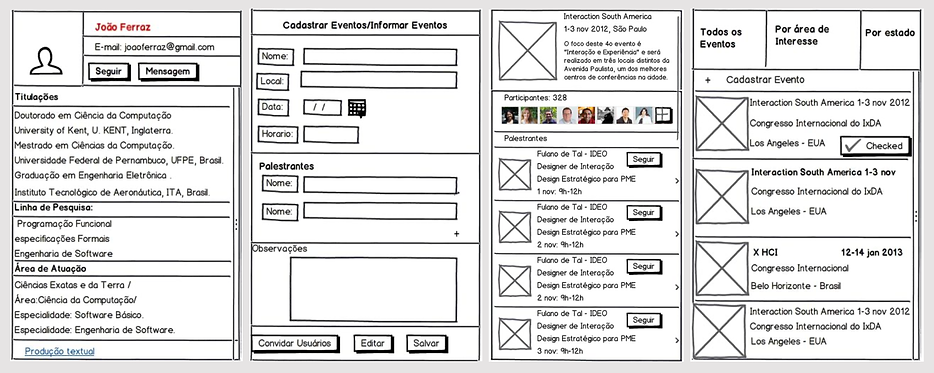
First Draft
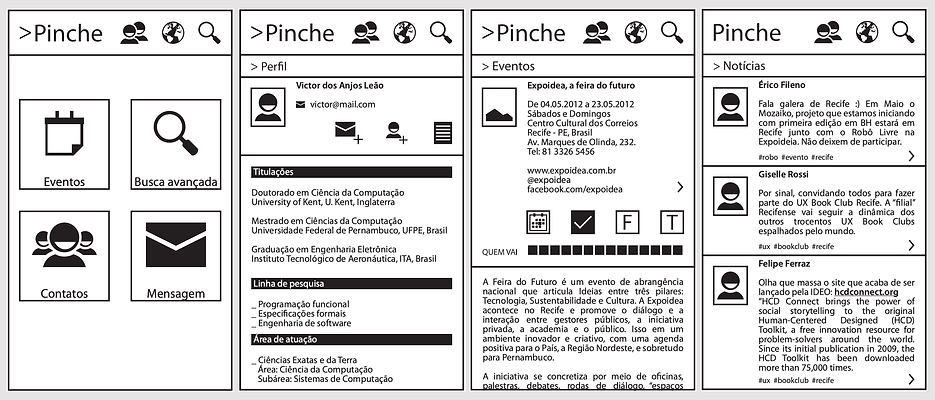
Wireframes
We ran a low-fidelity prototype test with 14 users to check our solutions. The team on this task was a notetaker and an interviewer/conductor of the usability test. We recorded the interactions on video, as well. The main metrics we analyzed in this step were (1) system learning curve, (2) task execution time, (3) user flow mistakes, and (4) qualitative response on satisfaction (using a unipolar 5-point scale).
In the end, we had overall positive feedback, besides an error on the iconographic ideas. A lot of users had a hard time understanding the icons' abstractions. Furthermore, with that in mind, we designed the visual mockups and animated on InVision to ran a high-fidelity prototype.


The high-fidelity prototype test was the last step of this project. We collected all data to elaborate and write an academic paper with the results.